
Details
DRM: Readium LCP DRM
Weitere Details
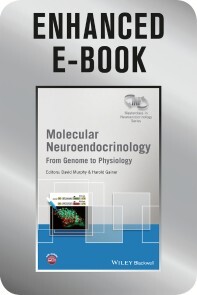
Molecular Neuroendocrinology
eBook - From Genome to Physiology, Wiley-INF Masterclass in Neuroendocrinology Series
Beschreibung
Molecular Neuroendocrinology: From Genome to Physiology, provides researchers and students with a critical examination of the steps being taken to decipher genome complexity in the context of the expression, regulation and physiological functions of genes in neuroendocrine systems.
The 19 chapters are divided into four sectors: A) describes and explores the genome, its evolution, expression and the mechanisms that contribute to protein, and hence biological, diversity. B) discusses the mechanisms that enhance peptide and protein diversity beyond what is encoded in the genome through post-translational modification. C) considers the molecular tools that todays neuroendocrinologists can use to study the regulation and function of neuroendocrine genes within the context of the intact organism. D) presents a range of case studies that exemplify the state-of-the-art application of genomic technologies in physiological and behavioural experiments that seek to better understand complex biological processes.
Written by a team of internationally renowned researchers
Both print and enhanced e-book versions are available
Illustrated in full colour throughout
This is the third volume in a new Series Masterclass in Neuroendocrinology , a co- publication between Wiley and the INF (International Neuroendocrine Federation) that aims to illustrate highest standards and encourage the use of the latest technologies in basic and clinical research and hopes to provide inspiration for further exploration into the exciting field of neuroendocrinology.
Series Editors: John A. Russell, University of Edinburgh, UK and William E. Armstrong, The University of Tennessee, USA
Über David Murphy, Harold Gainer
Professor David Murphy, University of Bristol, UK
As part of The Molecular Neueroendocrinology Research Group, Professor Murphy uses gene discovery and transfer techniques to study the neuronal regulation of the cardiovascular system in health and disease.
Dr Harold Gainer, National Institute of Neurological Disorders and Stroke (NINDS), USA
Dr Gainer's research focuses on the mechanisms involved in the establishment and maintenance of specific peptidergic neuronal phenotypes in the central nervous system.
Inhalt
List of Contributors, vii
Series Preface, xi
About the Companion Website, xiii
Introduction 1
David Murphy and Harold Gainer
Part A Genome and Genome Expression
1 Evolutionary Aspects of Physiological Function and Molecular Diversity of the Oxytocin/Vasopressin Signaling System 5
Zita Liutkeviciute and Christian W. Gruber
2 The Neuroendocrine Genome: Neuropeptides and Related Signaling Peptides 25
J. Peter H. Burbach
3 Transcriptome Dynamics 57
David A. Carter, Steven L. Coon, Yoav Gothilf , Charles K. Hwang, Leming Shi, P. Michael Iuvone, Stephen Hartley, James C. Mullikin, Peter Munson, Cong Fu, Samuel J. Clokie, and David C. Klein
4 New Players in the Neuroendocrine System: A Journey Through the Noncoding RNA World 75
Yongping Wang, Edward A. Mead, Austin P. Thekkumthala, and Andrzej Z. Pietrzykowski
5 Transcription Factors Regulating Neuroendocrine Development, Function, and Oncogenesis 97
Judy M. Coulson and Matthew Concannon
6 Epigenetics 121
Chris Murgatroyd
Part B Proteins, Posttranslational Mechanisms, and Receptors
7 Proteome and Peptidome Dynamics 141
Lloyd D. Fricker
8 Neuropeptidomics: The Characterization of Neuropeptides and Hormones in the Nervous and Neuroendocrine Systems 155
Ning Yang, Samuel J. Irving, Elena V. Romanova, Jennifer W. Mitchell, Martha U. Gillette, and Jonathan V. Sweedler
9 Posttranslational Processing of Secretory Proteins 171
Nabil G. Seidah and Johann Guillemot
10 Neuropeptide Receptors 195
Stephen J. Lolait, James A. Roper, Georgina G.J. Hazell, Yunfei Li, Fiona J. Thomson, and AnneMarie OCarroll
Part C The Tool Kit
11 Germline Transgenesis 219
Jim Pickel
12 Somatic Transgenesis (Viral Vectors) 243
Valery Grinevich, H. Sophie KnoblochBollmann, Lena C. Roth, Ferdinand Althammer,
Andrii Domanskyi, Ilya A. Vinnikov, Marina Eliava, Megan Stanifer, and Steeve Boulant
13 Optogenetics Enables Selective Control of Cellular Electrical Activity 275
Ryuichi Nakajima, Sachiko Tsuda, Jinsook Kim, and George J. Augustine
14 NonMammalian Models for Neurohypophysial Peptides 301
Einav Wircer, Shifra BenDor, and Gil Levkowitz
Part D Case Studies Integration and Translation
15 Osmoregulation 331
David Murphy, Jose AntunesRodrigues, and Harold Gainer
16 Food Intake, Circuitry, and Energy Metabolism 355
Giles S.H. Yeo
17 Stress Adaptation and the HypothalamicPituitaryAdrenal Axis 375
Greti Aguilera
18 Neuroendocrine Control of Female Puberty: Genetic and Epigenetic Regulation 405
Alejandro Lomniczi and Sergio R. Ojeda
19 Oxytocin, Vasopressin, and Diversity in Social Behavior 423
Lanikea B. King and Larry J. Young
Glossary 443
Index 459
E-Book Informationen
Alle hier erworbenen E-Books können Sie in Ihrem Kundenkonto in die kostenlose PocketBook Cloud laden. Dadurch haben Sie den Vorteil, dass Sie von Ihrem PocketBook E-Reader, Ihrem Smartphone, Tablet und PC jederzeit auf Ihre gekauften und bereits vorhandenen E-Books Zugriff haben.
Um die PocketBook Cloud zu aktivieren, loggen Sie sich bitte in Ihrem Kundenkonto ein und gehen dort in den Bereich „Downloads“. Setzen Sie hier einen Haken bei „Neue E-Book-Käufe automatisch zu meiner Cloud hinzufügen.“. Dadurch wird ein PocketBook Cloud Konto für Sie angelegt. Die Zugangsdaten sind dabei dieselben wie in diesem Webshop.
Weitere Informationen zur PocketBook Cloud finden Sie unter www.meinpocketbook.de.
Allgemeine E-Book-Informationen
E-Books in diesem Webshop können in den Dateiformaten EPUB und PDF vorliegen und können ggf. mit einem Kopierschutz versehen sein. Sie finden die entsprechenden Informationen in der Detailansicht des jeweiligen Titels.
E-Books ohne Kopierschutz oder mit einem digitalen Wasserzeichen können Sie problemlos auf Ihr Gerät übertragen. Sie müssen lediglich die Kompatibilität mit Ihrem Gerät prüfen.
Um E-Books, die mit Adobe DRM geschützt sind, auf Ihr Lesegerät zu übertragen, benötigen Sie zusätzlich eine Adobe ID und die kostenlose Software Adobe® Digital Editions, wo Sie Ihre Adobe ID hinterlegen müssen. Beim Herunterladen eines mit Adobe DRM geschützten E-Books erhalten Sie zunächst eine .acsm-Datei, die Sie in Adobe® Digital Editions öffnen müssen. Durch diesen Prozess wird das E-Book mit Ihrer Adobe-ID verknüpft und in Adobe® Digital Editions geöffnet.
Hinweis zu Readium LCP-Schutz
Bei E-Books die mit Readium LCP geschützt sind erscheint bei dem ersten Öffnen auf ihrem Reader ein Hinweisfenster mit der Aufforderung ein Passwort einzugeben. Gleichzeitig öffnet sich ein Infofeld in dem das Passwort steht. Tragen Sie dieses Passwort in das Eingabefeld ein und bestätigen Sie die Eingabe. Danach öffnet sich das E-Book automatisch. Um E-Books die mit Readium LCP geschützt sind auf einem Tablet/Laptop/Smartphone lesen zu können, benötigen Sie ein Programm, das in der Lage ist, mit diesem Kopierschutz umzugehen. Das ist z.B. der Thorium Reader (Windows, Mac, Linux) oder die PocketBook App (iOS, Android). Fügen Sie das heruntergeladene E-Book in das Programm ein. Bei dem ersten Öffnen erscheint ein Hinweisfenster mit der Aufforderung ein Passwort einzugeben. Gleichzeitig öffnet sich ein Infofeld in dem das Passwort steht. Tragen Sie dieses Passwort in das Eingabefeld ein und bestätigen Sie die Eingabe. Danach öffnet sich das E-Book automatisch.